Migration and Mental Health: The EU-MiCare Project Supports Professionals and Volunteers
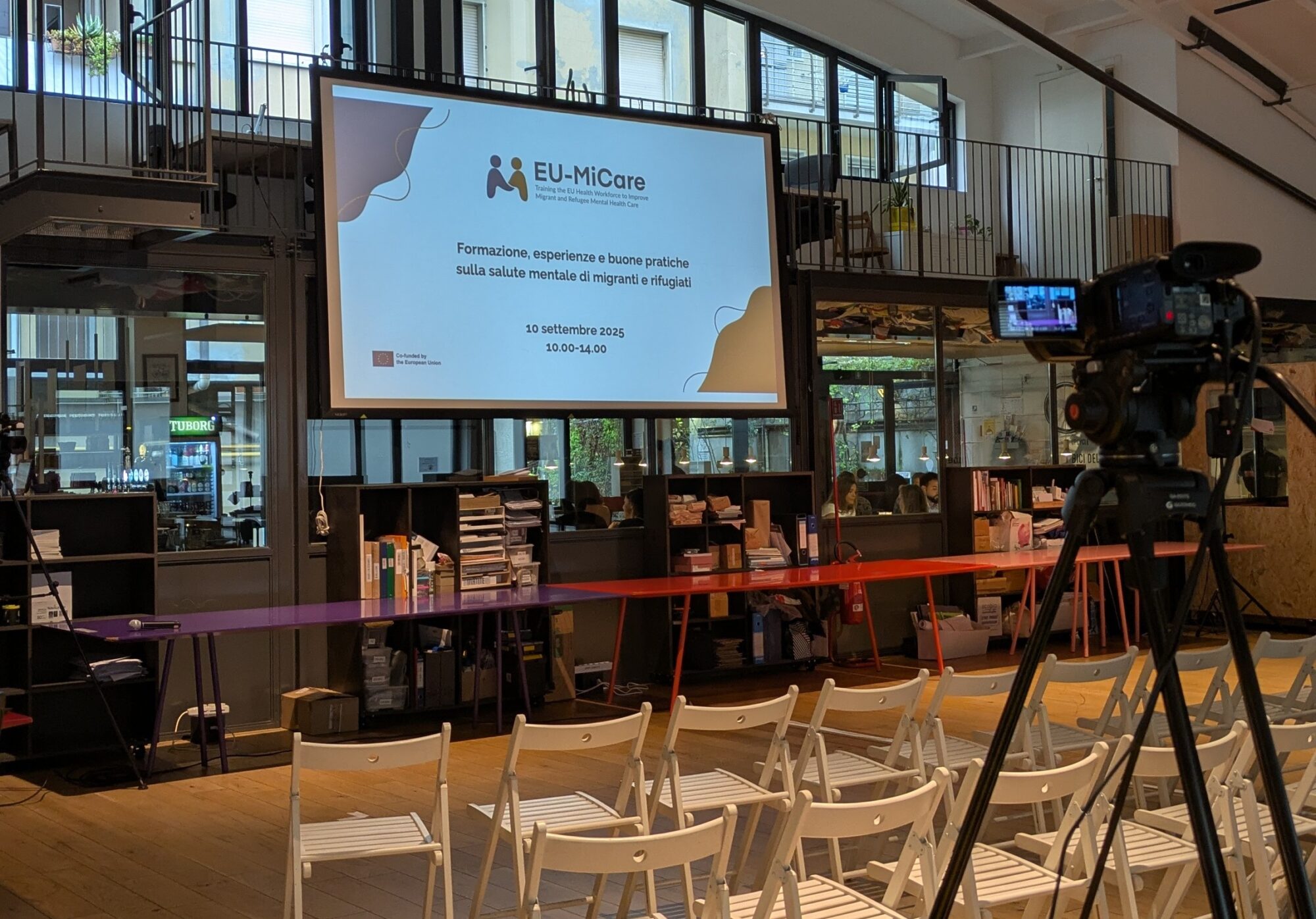
The national closing event of EU-MiCare, a three-year EU-funded project under the Erasmus+ programme, took place in Milan and provided an opportunity for meaningful exchange and discussion. The project is dedicated to professionals and volunteers working to support the mental well-being of migrants and refugees.
On 10 September 2025, the national closing event of EU-MiCare took place in Milan.
EU-MiCare is a three-year project funded by the Erasmus+ programme and dedicated to professionals and volunteers working in the field of mental well-being of migrants and refugees. The initiative stems from the growing awareness that migration is not a temporary crisis, but a structural reality that is reshaping societies and economies.
As recalled by Maria Rosa Valetto – who, together with Eva Benelli, coordinated the activities for Zadig, the Italian partner of the project – migrants’ health can become an entry point for renewing global solidarity and strengthening universal health coverage.
Project milestones
EU-MiCare builds on a pathway that began with the EU-VET CARE project, which focused on assistance for unaccompanied minors. In this new phase, the focus shifted to mental health, with the aim of strengthening the skills of healthcare and social care professionals, as well as volunteers, counsellors, interpreters and cultural mediators. The international consortium includes partners in Germany, Spain, Greece, Cyprus and Italy, under the coordination of the Ethno-Medizinisches Zentrum in Hannover.
The work started with a mapping of the situation in the participating countries, alongside focus groups that gathered the needs of sixty professionals. This process highlighted the need for a more structured and comprehensive training offer. To address this gap, the project developed a multilingual e-learning platform, free of charge and accessible to all professionals and volunteers. In its first four months, the platform involved around four hundred participants. The course will remain online for two years.
The training programme combines theoretical knowledge with practical tools, including screening sheets for the early identification of disorders, psychological first aid protocols, and guidelines for working in multi-professional teams. Significant attention is also devoted to the well-being of practitioners, who are often exposed to stress and feelings of inadequacy.
Voices and experiences in dialogue
The Milan event gave space to the experiences and activities of the project partners. The German group Ethno-Medizinisches Zentrum presented the MiMi model, which trains cultural mediators and produces multilingual guides to facilitate access to healthcare services. Conceived on the principles of social participation, empowerment and peer education, MiMi recruits, trains and networks multilingual transcultural health mediators, who then carry out campaigns within their own cultural communities to provide information on the German healthcare system, health challenges and healthy lifestyles. The use of multilingual signage and information materials, the development of local transcultural healthcare networks, and the evaluation and measurement of impact complete the model. In Germany, MiMi has been implemented in more than seventy-five locations, training 3,500 mediators and delivering over 13,000 information activities.
Psychiatrist Nicos Gionakis stressed the need not to reduce the migration experience to diagnostic labels such as post-traumatic stress disorder (PTSD), but to consider the complexity of individual experiences, living conditions, social support and reception policies. Gionakis introduced the concept of “nostalgic disorientation” to describe the loss of reference points and trust that follows the breakdown of stability, and invited participants to recognise the remaining resources and the potential for growth that can emerge from the experience of trauma. In this context, he referred to the authoritative approach developed by Renos Papadopoulos, which considers the migration experience in its complexity, uniqueness and totality, allowing one to see beyond the migrant/refugee label the person’s humanity and to recognise them as the protagonist of their own life-changing process. In particular, he recommended moving beyond the limited and limiting view of migrants as merely bearers of PTSD, and instead acknowledging both vulnerability and resilience, drawing on the “adversity grid”.
Considerable attention was devoted to the role of cultural mediators, who are crucial in overcoming linguistic and cultural barriers, especially in Italian reception centres where psychological support is not always available. Preparing asylum seekers for interviews with the Territorial Commissions, facilitating communication between professionals and service users, and ensuring conditions of cultural and gender safety are just some of the functions these professionals carry out on a daily basis.
Contributions came from Flavia Calò, psychologist and mental health lead for Médecins Sans Frontières’ humanitarian corridors programme; Sofia Carra, law student and volunteer providing legal assistance to asylum seekers with Naga ODV; Irene Carrano, psychologist and psychotherapist at Farsi Prossimo Onlus; Lorenzo Mosca, ethnopsychiatrist at the Social Outpatient Clinic for Mental Health, Casa della Carità in Milan; Ludovica Oliva, researcher at Università Luigi Bocconi, Legal Clinic on Rights and Vulnerability – San Siro Desk and the UASI Legal Clinic, Ukraine – Support and Information; and Elena Sacchi, linguistic and cultural mediator and legal officer at CAS Aquila in Milan, and social worker at France Terre d’Asile in Paris.
Testimonies from these different contexts provided concrete examples of reception practices in fragile neighbourhoods, spaces dedicated to privacy, mother–child groups and specific projects such as the humanitarian corridors from Libya, which have already enabled the arrival in Italy of more than four hundred people. Particular attention was paid to women and children, who often carry transgenerational trauma.
The day concluded with a broader reflection on the Italian service system. Many professionals highlighted the rigidity of institutions, exacerbated after the 2018–2019 decrees, and the need for stronger public–private collaboration. In the absence of a coherent national strategy, good practices risk remaining isolated, and the training of psychologists does not yet appear adequate to the objectives of transcultural psychiatry.
EU-MiCare has shown that it is possible to build shared training pathways based on concrete experiences and scientifically validated approaches. The hope, recalled by Eva Benelli in her closing remarks, is that this project will represent not an endpoint, but a building block in a longer journey, capable of strengthening the connection between health, migration and social inclusion.